Loan Reject··Updated
Bank said existing EMIs are too high
They added every instalment you already pay. The new EMI would not fit. This is FOIR, not a personal insult.

The SMS landed first.
"We are unable to sanction additional unsecured credit due to existing obligations."
You were not looking for a speech. You wanted someone to point at one line on the report — or at the one paper the desk actually wants — and say what it means in ordinary English.
What that message is actually saying
Your income is already pledged on paper. The new EMI would push the ratio past their cap. Card minimums, auto loans, gold loans, and sometimes even education-loan EMIs go into that bucket. The officer saying ‘EMI zyada hai’ is repeating the grid.
Lenders reuse short phrases because they are cheap to send. Policy norms, under review, minus applicable charges, visit branch: each one hides a list. Your job is to pull that list out of the PDF or the document packet, not to decode the officer's mood in the corridor.
If the branch suggests a top-up on an existing loan instead of a second personal loan, compare the rate and the tenure, not the monthly ‘relief’. Longer tenure can look like a smaller EMI while you pay more interest. Do that maths at home, not at the counter under fluorescent lights.
The one report line to read first
Open the consumer report you downloaded from the official bureau path. Ignore the decorative score ring for a minute. Find this kind of line:
Open trades · auto loan EMI, personal loan EMI, credit card · current balances listed in a stack
Add the EMIs the report implies. Cards are messy because utilisation can be treated as a high burden even without a converted EMI. If you have a card at 90% limit, expect the engine to be nervous. Closing a small loan after paying it can free ratio, but only after the member reports the closure.
This is arithmetic. Income in, EMIs out. If the leftover is thin, unsecured lenders leave. You can wait for a closure to report, cut card balances, or pick a smaller ticket. You cannot argue that ‘I always pay’ as a substitute for ratio.
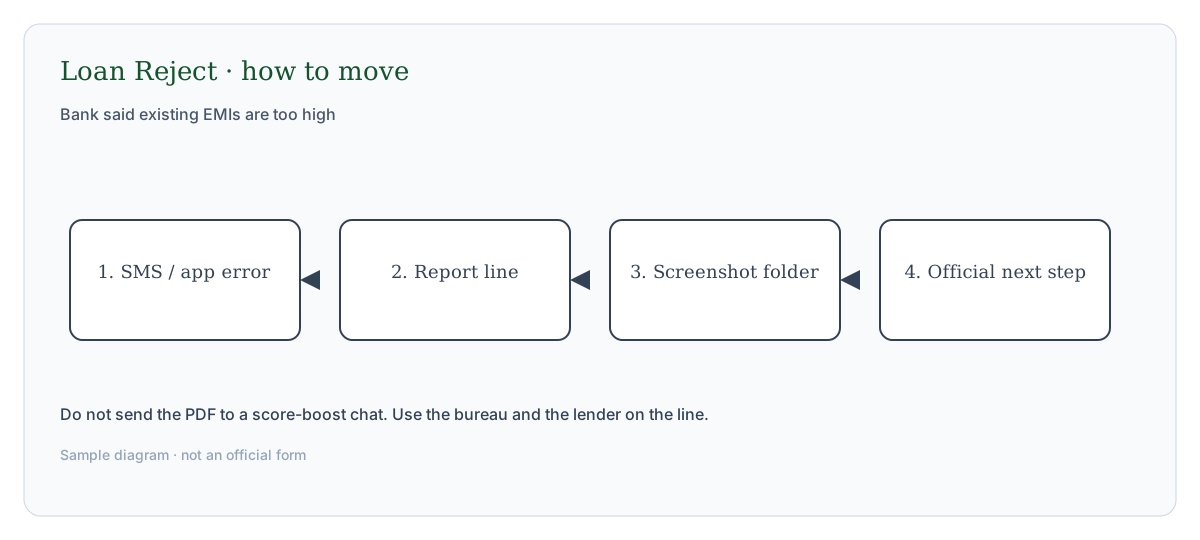
Screenshot the error. Skip the 7-day score ads
Bureau open-account page, a handwritten EMI total, and last three salary credits. That packet is the whole conversation.
Balance-transfer ads that hide a processing fee can leave you with two EMIs for a month. Read the payoff letter dates.
If a page promises a score of 800 in seven days, close it. If a stranger wants remote access to 'clean CIBIL', close that too. The official bureau site and the lender that holds the account are the two doors that count. Everything else is noise with a PAN field.
Keep the screenshots in a folder named with the date. When you visit a branch, you are not performing. You are showing two or three pictures and asking which of those pictures they used.
What to do this week
- Make a table of every EMI and card utilisation.
- Decide which small loan can be closed without a painful penalty.
- After closure, wait for the bureau to show zero, then apply once.
- If cards are the problem, pay utilisation down and wait one bill cycle to report.
- Ask for a smaller amount if you still want credit this quarter.
People forget a spouse’s loan they guaranteed. Guarantor lines can still worry some files. People also forget a phone EMI that reports as a consumer durable. Another mix-up: thinking a moratorium means the EMI is gone. The account may still be open.
Leave these ideas aside
Do not hide an EMI by stopping auto-pay for one month to ‘look free’. A bounce will make FOIR worse, not better.
A helper blog cannot sit in the dispute queue for you. It cannot call recovery. It cannot promise a sanction. It can tell you to read the line, keep the screenshot, and use the official form.
If the file is personal — a court remark, a guarantee, a joint loan after a breakup — take the PDF to the lender and, where the facts are heavy, to a qualified adviser. Do not crowd-source the next step in a comment section.
A calm way to talk at the branch
Carry the SMS, the PDF page, and one proof (payment, offer letter, KYC, valuation slip — whichever this problem needs). Ask three questions only: which line they used, which document is missing, and whether a cool-off applies before you apply again. Write the answers in your notes app. That is a better meeting than a twenty-minute speech about how decent your salary feels on WhatsApp.
If they repeat "policy norms" and nothing else, use their grievance mail with the application number. You may still get a short code. The bureau page will still be more honest than the corridor.
FAQ
Which EMIs do they count?
Usually all reported instalments. Some shops also impute a load for high card balances. Assume they can see what the bureau shows.
Does a joint home loan count fully against me?
Often they take the contractual EMI. Some may split. Do not assume a 50% gift.
Will a salary certificate without a new credit help?
No. They need the ratio, not a letter that says you work hard.
Can I shift EMIs to a parent’s name?
Not as a trick. Genuine transfer follows lender process. Fake shifting is fraud.
Short disclaimer
Loan Atka is not a bank and not a CIBIL office. Score formulas belong to the bureau. No article can guarantee approval, a deleted enquiry, or a higher number next week. The official report and the lender letter are final for your file. For a personal case, speak to the bank or NBFC that holds the account.
Why this sits in Loan Reject
This piece is filed under Loan Reject because that is the shelf where the first screenshot usually belongs. You may still need a second shelf — a KYC letter as well as a bureau line, or a foreclosure quote as well as a DPD cell. Start on this shelf so you do not wander into a random 'score boost' page that has nothing to do with bank said existing emis are too high.
The tagline of this site is crude on purpose. If CIBIL is not opening, if a loan is rejected, if a card bill is late, check the line before you stand in the bank queue. That is the whole method. It works on this problem the same way it works on the other thirty-nine.
Loan Atka is a helper blog. The official bureau report is the one that counts. For your own file, talk to the bank or NBFC that holds the account.


